 July 9, 2026
 Scale and grow with eMAM™
Media organizations do not all need the same media asset management footprint on day one. Some teams start with the need to preserve and retrieve valuable content. Others need secure sharing, publishing, and delivery. As workflows mature, production teams need deeper collaboration, editorial access, review and approval, and automation across departments. Eventually, large organizations require redundancy, high availability, and the ability to scale users, processing, and locations without disrupting day-to-day operations.
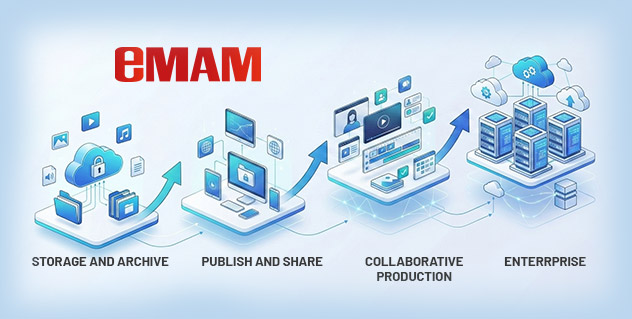
The eMAM product line supports this progression with a clear scaling model: begin with eMAM Vault for storage and archive management, expand with eMAM Publish for sharing and publishing, move into collaborative production with eMAM Workgroup, and scale to high availability and redundancy with eMAM Enterprise.
1. Storage and Archive Management with eMAM Vault
eMAM Vault is the practical starting point for organizations that need to bring control to growing media libraries. The primary goal is to stop media from being isolated across hard drives, shared folders, unmanaged cloud buckets, or disconnected archive systems. Vault creates a centralized system where users can ingest assets, organize them with metadata, search across libraries, preview lightweight proxies, and retrieve high-resolution media when needed.
This stage is especially important for cost control and preservation. Everything will be indexed in eMAM to ensure it is protected and discoverable. High-resolution media can remain in lower-cost storage or archive tiers while users work from proxies for browsing, logging, and selection. With supported archive environments, users can restore needed content instead of keeping everything permanently online. Vault also lays the metadata foundation for every future stage: if assets are well organized at the archive level, they become easier to publish, collaborate on, monetize, and reuse later.
Typical outcomes at this stage: fewer lost assets, lower storage pressure, faster search and retrieval, stronger preservation practices, and a cleaner foundation for future workflow automation.
Best fit: organizations that have large media libraries, archive-heavy operations, legacy content that needs to be organized, or teams that need to reduce dependency on unmanaged storage.
2. Sharing and Publishing with eMAM Publish
Once assets are under control, the next scaling step is making them useful beyond the archive. eMAM Publish extends the system from preservation into secure access, review, sharing, digital delivery, and publishing. Instead of downloading files manually, emailing links from separate tools, or tracking approvals in disconnected threads, teams can use the MAM as the coordination point for controlled distribution.
Publish is especially valuable for marketing, distribution, education, corporate communications, broadcast support, agency collaboration, and partner-facing workflows. Users can prepare assets for delivery, share review links, support approval cycles, publish to approved destinations, and deliver high-resolution content in required formats. This turns the archive into an active distribution engine while keeping visibility into who accessed content, which version was approved, and where media was sent.
At this stage, the MAM is no longer only a place to store media. It becomes an operational platform for controlled sharing and publishing. Teams can reduce manual handoffs, improve brand consistency, protect rights and permissions, and accelerate delivery to internal teams, external partners, social platforms, websites, video services, and other approved endpoints.
Typical outcomes at this stage: faster review cycles, more secure external sharing, fewer ad hoc transfers, better version control, and more consistent delivery to audiences and platforms.
Best fit: organizations that need to distribute finished media, support partner access, publish content across destinations, or manage review and approval without losing control of source assets.
3. Collaborative Production with eMAM Workgroup
As more users depend on the MAM, the workflow naturally expands from sharing finished content to supporting active production. eMAM Workgroup adds the collaborative layer that production teams need: project organization, user permissions, review and approval, metadata updates, proxy workflows, creative tool integrations, and shared access for technical and non-technical stakeholders.
Workgroup is designed for departments, production groups, and midsize organizations that need multiple teams to work from a common system of record. Editors, producers, marketers, operations teams, customers, and external collaborators can all interact with the same managed assets according to their role. This reduces duplicated files, version confusion, disconnected review cycles, and the risk of teams making decisions from outdated media.
This is the point where MAM becomes production infrastructure. Rather than managing files only after a project is complete, the system supports the work while it is happening. Teams can organize projects, find source media faster, collaborate on editing, manage approvals, connect production and distribution workflows, and maintain a more accurate record of decisions throughout the media lifecycle.
Typical outcomes at this stage: smoother handoffs between production roles, fewer duplicated assets, better project visibility, stronger accountability, and faster movement from edit to approval to delivery.
Best fit: production departments, creative teams, agencies, broadcasters, corporate media teams, and organizations that need collaborative production asset management across multiple roles or business units.
4. High Availability and Redundancy with eMAM Enterprise
For large organizations, scaling is not only about more users or more storage. It is about reliability, performance, geographic reach, organizational complexity, and business continuity. eMAM Enterprise builds on the capabilities of Vault, Publish, and Workgroup to support major organizations that require redundancy, expanded processing, additional web access, multiple server components, and resilient deployment patterns.
Enterprise is the destination for organizations that need the MAM to operate as a mission-critical system. Additional server components can support scaling and disaster recovery, while options for more users, organizational units, app nodes, and web nodes help the system grow alongside content volume, workflow complexity, and distributed teams. This makes it possible to support larger user communities, more processing demand, and more locations without redesigning the workflow from scratch.
With Enterprise, the scaling path becomes complete: Vault establishes control, Publish extends distribution, Workgroup powers collaboration, and Enterprise adds the resiliency and capacity required for the largest media operations. The result is a platform that can support enterprise-wide media operations across departments, locations, storage environments, and production teams.
Typical outcomes at this stage: stronger uptime planning, improved disaster recovery readiness, greater processing capacity, support for larger user populations, and more resilient access for distributed media teams.
Best fit: major media organizations, broadcasters, large enterprises, government agencies, education networks, and any organization where MAM uptime, redundancy, and scale are operational requirements.
Scaling Path at a Glance
1. eMAM Vault: control storage and archive with searchable access, proxies, metadata, and retrieval workflows.
2. eMAM Publish: expand into secure sharing, review, delivery, and publishing to internal and external destinations.
3. eMAM Workgroup: support collaborative production with project-based workflows, role-based access, approvals, and creative team coordination.
4. eMAM Enterprise: scale to mission-critical operations with high availability, redundancy, additional components, and enterprise-wide capacity.
Conclusion
The strongest MAM strategy is one that can start focused and scale without forcing a restart. eMAM gives organizations a practical progression: protect and organize content with Vault, share and publish with Publish, collaborate in production with Workgroup, and support enterprise-level resiliency with Enterprise.
This model allows media teams to invest at the level they need today while preserving a path to larger workflows tomorrow. Whether the priority is archive control, distribution, production collaboration, or high availability, the same platform family can grow with the organization.
Start with the workflow you need now. Scale to the workflow your organization needs next.