Home / The Power of Deployment Flexibility
The Power of Deployment Flexibility
-Marc Benioff
The Power of Deployment Flexibility
Media asset management (MAM) platforms sit at the center of how organizations create and use rich media. As video becomes a default format for internal communications, marketing, training, product documentation, customer support, and broadcast or streaming operations, the platform must be both reliable and adaptable. The ability for a solution to run on premise, in the cloud, or as a hybrid architecture gives organizations the flexibility to match technology to business requirements-rather than forcing business processes to conform to a single deployment model. This post explains how each environment supports different priorities (control, speed, scalability, cost, compliance, and resilience), and why multi-environment support enables organizations to evolve over time without replatforming their entire media workflow.
1. Why MAM Deployment Flexibility Matters and How eMAM Supports It
At a basic level, a MAM system manages the full lifecycle of media assets: capture or ingest, metadata entry and enrichment, proxy generation, search and retrieval, collaborative production, review and approval, rights and retention management, and distribution to downstream systems (playout, web publishing tools, or learning platforms), with secure archive for future use. Modern MAM deployments also integrate with identity and access management (for role-based permissions), automation/orchestration engines, and analytics that track who uses the assets and how they are used.
Key factors for the deployment of a MAM are:
- File size and latency
- Security requirements
- Location of key staff and stakeholders
- Variability in media volume creation and consumption
- Total cost of ownership
eMAM provides full support for any deployment model with its distributed, modular architecture. Components can be deployed in any number of local or cloud systems to provide seamless orchestration of workflow processes. These can be changed as needed on the fly by staff or partners to meet the current and future needs of any organization.
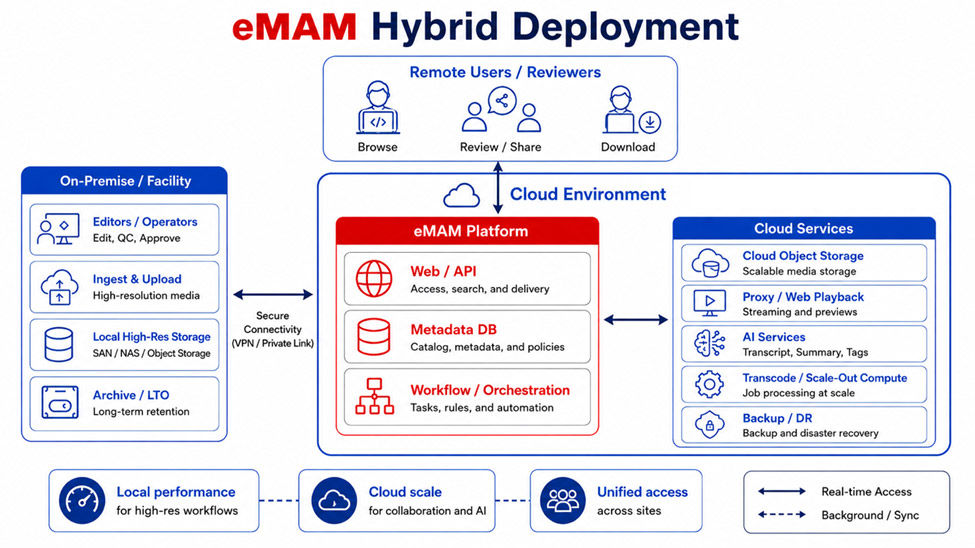
eMAM is especially strong in hybrid deployments because of its distributed, modular architecture. Organizations can keep high-resolution media, sensitive assets, archive systems, and performance-critical production workflows on premise while extending selected services to the cloud for remote access, AI enrichment, scalable processing, collaboration, delivery, backup, and disaster recovery. This allows local editors to work with fast shared storage while remote producers, clients, and reviewers securely access proxies, metadata, transcripts, and approvals through the web.
eMAM deployments can also be configured and reconfigured as business needs change. A customer may start with an on-premise system, add cloud-based review and approval, then enable cloud transcode or AI indexing, and eventually expand to disaster recovery or multi-site collaboration. Storage locations, proxy workflows, archive targets, delivery profiles, user permissions, metadata structures, and workflow rules can be adjusted over time. This gives organizations the freedom to evolve from on premise to hybrid, from hybrid to cloud, or to maintain a balanced multi-environment architecture without rebuilding the foundation of their media workflow. Many eMAM customers have staff reconfigure settings on the fly, resulting in flexibility at little or no cost.
2. On-Premise MAM: Control, Predictable Performance, and Data Governance
On-premise deployment places the MAM application, databases, and primary storage inside an organization’s facilities (or within a privately managed data center). For many organizations, this model remains attractive because it maximizes direct control over infrastructure, network design, and security tooling. When media teams work in a centralized location-such as a broadcast facility, studio, stadium, or corporate campus -on-premise MAM can deliver highly predictable performance. High-bandwidth local networks (10/25/40/100GbE) and low-latency access to shared storage can make tasks like editing, conform, color correction, finishing, and large-batch transcodes faster and more consistent than sending terabytes across the public internet.
On-premise architectures also align well with strict governance requirements. Organizations with sensitive footage, unreleased product information, regulated records, or contractual restrictions may prefer to keep “crown jewel” content behind internal firewalls and under established security monitoring. On-premise deployments can integrate tightly with existing systems such as legacy video servers, nearline libraries, tape archives, newsroom systems, or specialized storage tiers. In environments where workflows are already built around local shared storage with purpose-built hardware (for example, GPU transcode appliances or high-end finishing suites), an on-premise MAM can reduce disruption and preserve investments.
Spending may also be a compelling factor. Organizations with traditional procurement processes can budget for the lifetime total cost of ownership of a system over the expected life cycle of the solution, without unknown and variable costs. A LTO library can run for years with very little operational costs, storing vast quantities of media that are readily discoverable and accessible through the MAM.
The main tradeoffs for on premise systems are cost structure and agility. On-premise deployments often require capital expenditures for servers and storage, lead time for procurement, and ongoing effort for patching, upgrades, and capacity planning. Scaling for a short-term spike-such as a major sports event, product launch, or sudden increase in content localization-can be difficult if hardware must be purchased and installed. Finally, as teams become more distributed, keeping workflows fully on premise can create challenges for remote contributors who need secure access to proxies, review tools, and metadata. These pressures are why many organizations evaluate cloud options for all or part of the MAM stack.
3. Cloud MAM: Elastic Scale, Faster Time-to-Value, and Global Collaboration
A cloud deployment runs MAM services on public (or private) cloud infrastructure, typically pairing object storage for media with scalable compute for transcode, AI-based enrichment, and web-based review. The primary advantage is elasticity: organizations can scale storage and processing capacity up or down without buying hardware. This is particularly valuable when media usage is uneven-seasonal campaigns, episodic productions, event-driven content, or rapid growth in video training libraries.
The cloud also reduces time-to-value because infrastructure and services can be provisioned quickly, and many operational tasks (hardware refresh, underlying platform resilience, regional availability) are handled by the cloud provider. Staff and space used to support local systems can be minimized.
Cloud MAM can also enable a “work from anywhere” operating model. Proxies, metadata, and review interfaces can be accessed securely by employees, contractors, and agencies across regions, making it easier to run 24/7 workflows and shorten turnaround times. Global distribution features-such as replicating content to multiple regions-can improve responsiveness for geographically dispersed teams. Disaster recovery is often simpler to implement because data can be stored redundantly across zones or regions, and compute resources can be re-created if an incident occurs. Financially, cloud can shift spending toward operating expense, aligning cost with usage and allowing organizations to treat large-scale transcodes or AI enrichment as burstable workloads.
However, cloud deployments introduce their own constraints. Moving high-resolution media in and out of the cloud can be time-consuming, and recurring data transfer charges may become significant, depending on distribution patterns. Workflows that require ultra-low latency access to uncompressed or high-bitrate content (editing, color correction, etc) will perform better on local networks. While cloud systems offer world-class security feature beyond the capability of small or medium sized organizations, some organizations face regulatory or contractual obligations that limit where data may reside, or they may require specialized security controls and audit processes. These considerations often lead to the most common real-world approach: hybrid MAM, where on-premise and cloud resources are combined intentionally.
4. Hybrid MAM: Putting the Right Workloads in the Right Place
Hybrid MAM combines on-premise and cloud components so that organizations can optimize for multiple goals at once. Although it can used temporarily, many media teams use it as a long-term operating model: keep performance-critical or highly sensitive assets on premise while using cloud services for collaboration, easy scaling, automation, and resilience. The key benefit is workload placement. Organizations can decide where different parts of the workflow should run based on bandwidth, latency, cost, compliance, and user experience.
Common hybrid patterns include: (1) keeping high-resolution masters in on-premise shared storage while synchronizing proxies and metadata to the cloud for review, approvals, and remote searching; (2) “bursting” compute-intensive jobs such as heavy transcoding or renditions-o cloud instances during peak demand; (3) using cloud storage as an offsite backup or disaster-recovery tier while retaining primary working storage locally; and (4) supporting multi-site organizations by using the cloud as a hub that indexes assets from several facilities while each location maintains local storage for day-to-day editing.
Just as important, hybrid architectures enable phased change. Organizations rarely overhaul media infrastructure all at once; they modernize in stages while maintaining continuity for ongoing productions and business operations. A MAM that supports hybrid deployment lets teams migrate selected workflows to the cloud (such as review-and-approve or archive) while keeping established on-premise systems running. Over time, the balance can shift as connectivity improves, governance policies mature, and stakeholders gain confidence in new operating models. In this way, hybrid capability is not only a technical feature but also a risk-management strategy.
5. How Multi-Environment MAM Support Maps to Real Organizational Needs
5.1 Security, Privacy, and Compliance
Different organizations face different risk profiles. A defense contractor, healthcare provider, or financial institution may prioritize data residency, strict access controls, and auditability; a media company may prioritize rights management and embargo controls; a retailer may prioritize brand governance and rapid distribution. When a MAM can run on premise, teams can enforce highly customized network segmentation and align with internal security operations. When it can run in the cloud, teams can leverage managed encryption, centralized identity integration, and region selection to meet residency requirements. Hybrid models allow “separation of duties” at the infrastructure level-for example, keeping protected masters on premise while still enabling broad discovery and review of proxies in the cloud.
5.2 Performance, Latency, and User Experience
Media workflows are unusually sensitive to throughput and latency. Editors and colorists often need sustained bandwidth for high-bitrate formats, while producers and stakeholders need responsive playback for review. On-premise MAM can deliver excellent performance when users and storage are co-located. Cloud MAM excels when the primary interaction is web-based review on proxies, when teams are geographically distributed, or when content must be delivered quickly to multiple regions. Hybrid offers a pragmatic “best of both”: local performance for high-resolution finishing paired with cloud-based access for collaboration and approvals.
5.3 Scalability, Agility, and Innovation
The pace of change in media is rapid: new formats, new channels, and rising expectations for personalization and localization. Cloud deployments allow teams to add capacity quickly, experiment with new automation, and integrate AI services for transcription, translation, scene detection, or content moderation without procuring specialized hardware. Even organizations that maintain on-premise systems can benefit from cloud-connected innovation by using hybrid models to route specific tasks-such as tagging large libraries-into cloud services, while keeping the rest of the workflow local.
5.4 Cost, Budgeting, and Total Cost of Ownership
Financial flexibility is a major reason organizations value multi-environment support. On-premise systems can be cost-effective for steady, high-volume workloads where hardware is fully utilized over time, and where cloud egress charges would be substantial. Cloud models can reduce upfront investment and align costs with production cycles, which is appealing for organizations that ramp up and down. Hybrid approaches can control cloud costs by limiting data movement (for example, keeping high-resolution masters local) while still taking advantage of on-demand compute and cloud-based collaboration.
5.5 Resilience, Disaster Recovery, and Business Continuity
Media libraries are long-lived, and downtime can be expensive-missed air times, delayed launches, or stalled internal communications. On-premise environments can be engineered with redundancy, but building a second site and replicating petabytes of media is costly. Cloud can provide resilient storage and rapid recovery options, while hybrid can deliver a practical balance: keep operations running locally, replicate critical assets or project files to the cloud, and maintain the ability to restore services if a facility is unavailable. In many organizations, hybrid MAM becomes part of the broader business continuity plan rather than an isolated media technology decision.
5.6 Integration with Existing Tools and Workflows
MAM rarely exists alone. It must connect to editing software, storage tiers, authentication systems, project management tools, content management systems, distribution platforms, and sometimes specialized broadcast or archival technologies. On premise deployments may simplify integration with legacy systems that were not designed for cloud connectivity. Cloud deployments can accelerate integration with the newest tools and APIs. Hybrid support allows organizations to keep legacy integrations stable while incrementally modernizing-protecting current operations while still moving toward more automated, API-driven workflows.
6. Practical Scenarios Where On Premise, Cloud, and Hybrid Flexibility Pays Off
Broadcast and news operations: Broadcasters often rely on facility-based shared storage and time-critical production. An on-premise MAM supports fast ingest and editing close to the action, while a hybrid extension can publish proxies and metadata to the cloud for remote producers, legal review, and fast distribution to digital platforms. If a breaking story requires rapid scaling of transcode or clipping workflows, cloud compute can absorb the burst without purchasing or provisioning for additional on-premise hardware.
Sports and live events: Venues and leagues may capture enormous volumes of footage over short periods. On-premise systems at a stadium can ensure reliable ingest and immediate access for highlight creation. Cloud components can then support rapid distribution to regional social teams and partners, and they can scale for high-demand moments. Hybrid approaches also simplify long-term storage by moving completed event packages to cloud archival tiers while keeping current-season material on faster local storage and archive.
Corporate marketing and brand teams: Marketing organizations frequently collaborate with external agencies and need controlled access to brand-approved assets. A cloud MAM can simplify secure sharing, approvals, and global distribution of finished content and templates. If product launch materials are highly confidential, a hybrid model can keep masters and sensitive pre-release footage on premise while still enabling cloud-based review for approved stakeholders of derivatives or less restricted media.
Training, education, and internal communications: Organizations building large libraries of training videos often prioritize easy access, searchability, and integration with learning platforms. Cloud MAM can make it simpler to deliver content to distributed employees and track usage. When training includes sensitive operational footage, hybrid patterns can store masters on premise while using cloud proxies and metadata to support search, captions, and controlled playback.
Regulated or high-assurance environments: In sectors where audits, retention, and evidence handling matter, on-premise deployment may be required for certain asset classes. Even then, cloud services can add value for non-sensitive derivatives-such as generating transcripts, indexing content, or enabling remote review under controlled conditions. A MAM that supports both environments allows organizations to meet regulatory requirements without foregoing modern collaboration and automation capabilities.
7. Implementation Considerations to Realize the Benefits of Flexibility
Deployment flexibility creates options, but it also requires deliberate design. Organizations should first define which assets must remain on premise (due to sensitivity, performance, or contractual restrictions) and which can move to the cloud. Clear data classification-masters, mezzanine files, proxies, project files, and metadata-helps avoid costly data movement and reduces risk. Network planning is equally important: hybrid models depend on reliable connectivity, appropriate bandwidth for scheduled transfers, and controls that prevent accidental egress of high-cost or restricted content.
Operationally, teams should plan for identity and permissions, logging and audit trails, encryption and key management, and consistent lifecycle policies (retention, tiering, and deletion). The organization’s operating model matters as much as its architecture: who owns upgrades, how incidents are handled, what service levels are required for production versus archive, and how users are onboarded. When these practices are in place, multi-environment MAM becomes a strategic platform that can adapt as the organization’s content volume, workforce distribution, and risk tolerance change.
8. Conclusion
The value of MAM is measured by how well it supports real media work: finding the right asset quickly, collaborating efficiently, protecting content appropriately, and delivering on time. Because organizations vary widely in their security constraints, performance needs, geographic footprint, and budget models, no single deployment environment is universally best. A MAM that can operate on premise, in the cloud, and in hybrid configurations gives organizations the flexibility to place workloads where they make the most sense-keeping high-value or latency-sensitive work close to local systems while using the cloud for scale, collaboration, automation, and resilience. Most importantly, this multi-environment capability allows organizations to evolve as their needs change, adopting new workflows and technologies without repeatedly rebuilding the foundation of their media operations.

| Component / License | eMAM Enterprise | eMAM Workgroup | eMAM Publish | eMAM Vault | eMAM Cloud Service | eMAM Cloud Platform | ||||||
|---|---|---|---|---|---|---|---|---|---|---|---|---|
| Use Case | Large Enterprise Customers |
Production Management & Content Sharing |
Sharing of Media |
Archive & Storage Management |
Preserve: Cloud Storage | Create: Collaborative Production |
Archive: Intelligent Storage | Production: Collaborative Production |
||||||
| Storage Support | On premise & Cloud |
On premise & Cloud |
On premise & Cloud |
On premise & Cloud |
Included |
Included |
||||||
| Cloud Archive | Included |
Included |
Included |
Included |
Included |
Included |
||||||
| User Licenses Included | 50 |
25 |
10 |
5 |
10 |
10 |
||||||
| Storage and File Licenses | Unlimited |
Unlimited |
Unlimited |
Unlimited |
Preserve: 5TB Archive |
Unlimited |
||||||
| License Options | Purchase & Subscribe |
Purchase & Subscribe |
Purchase & Subscribe |
Purchase & Subscribe |
1 Month, 1 Year, or Multi-Year |
Hourly with Annual Discount |
||||||
| Product Features | eMAM Enterprise | eMAM Workgroup | eMAM Publish | eMAM Vault | eMAM Cloud Service | eMAM Cloud Platform | ||||||
Organizational Units |
Optional |
Optional |
Optional |
Only 1 |
Only 1 |
Only 1 |
||||||
Ingest and Organize |
Yes |
Yes |
Yes |
Yes |
Yes |
Yes |
||||||
Search, Browse, Tag, & Metadata |
Yes |
Yes |
Yes |
Yes |
Yes |
Yes |
||||||
AI Tagging |
Optional |
Optional |
Optional |
Optional |
Up to 10 Hours |
Billed to Customer Account |
||||||
Review & Approval |
Internal & External |
Internal & External |
Internal & External |
Internal |
Preserve: Internal |
Archive: Internal |
||||||
Subclip |
Yes |
Yes |
Yes |
Yes |
Preserve: Internal |
Archive: Internal |
||||||
Partial Restore |
Yes |
Yes |
Yes |
Yes |
Preserve: No |
Archive: No |
||||||
Delivery with Transcoding |
Yes |
Yes |
Yes |
Yes |
N/A |
N/A |
||||||
Adobe Creative Cloud (PAM) |
Yes |
Yes |
No |
No |
Preserve: No |
Archive: No |
||||||
eShare - Link Sharing |
Yes |
Yes |
Yes |
No |
Yes |
Yes |
||||||
eSend - Email Sharing |
Yes |
Yes |
No |
No |
Preserve: No |
Archive: No |
||||||


